> For the complete documentation index, see [llms.txt](https://docs.jigx.com/llms.txt). Markdown versions of documentation pages are available by appending `.md` to page URLs; this page is available as [Markdown](https://docs.jigx.com/examples/readme/data-providers/dynamic-data/reading-dynamic-data.md).
# Reading Dynamic Data
In this example, we **read** the employee data records we created in the employee Dynamic Data table ([Creating Dynamic Data](/examples/readme/data-providers/dynamic-data/creating-dynamic-data.md)), to create a list of the employees and their details.
## Datasources, jig & component
1. **default.jigx** is the database where the Dynamic Data table is defined.
2. [sqlite](/examples/readme/datasource/sqlite.md) datasource calls the Dynamic Data provider, using an SQL query to return the data.
3. [jig.list](/examples/readme/jig-types/jig_list.md) is the type of jig we will use to list the data.
4. [expander](/examples/readme/components/expander.md) component to show the Dynamic Data in.
## Examples and code snippets
This example uses the Dynamic Data table, columns, and data records created in the [Creating Dynamic Data](/examples/readme/data-providers/dynamic-data/creating-dynamic-data.md) example to create a list of employees with their details.
Reading Dynamic Data
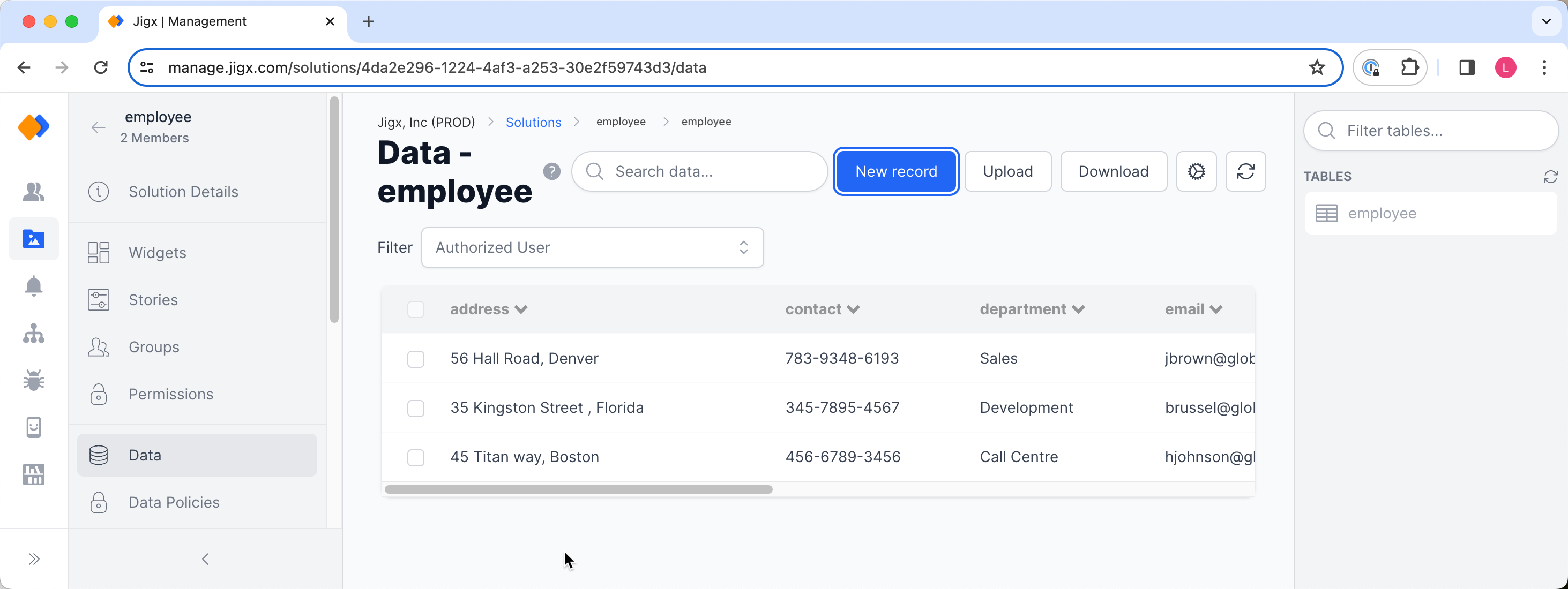
Here is what the data table employee resembles in [Data](https://docs.jigx.com/building-apps-with-jigx/data) in Jigx Management.
Employee Dynamic Data
{% tabs %}
{% tab title="list-employees.jigx" %}
{% code fullWidth="true" %}
```yaml
title: Employee list
type: jig.list
icon: list-stars
header:
type: component.jig-header
options:
height: medium
children:
type: component.image
options:
source:
uri: https://images.unsplash.com/photo-1531545514256-b1400bc00f31?q=80&w=1374&auto=format&fit=crop&ixlib=rb-4.0.3&ixid=M3wxMjA3fDB8MHxwaG90by1wYWdlfHx8fGVufDB8fHx8fA%3D%3D
# Use onfocus action to sync the data from the provider everytime the jig is opened
onFocus:
type: action.action-list
options:
isSequential: true
actions:
- type: action.sync-entities
options:
# The dynamic provider has the employee table and records that must sync when the jig is opened
provider: DATA_PROVIDER_DYNAMIC
entities:
- default/employee
datasources:
my-employees:
# Use the SQLite data source to write a select query to return the exact data from the solution's Dynamic Data employee table to be used in the jig
type: datasource.sqlite
options:
provider: DATA_PROVIDER_DYNAMIC
entities:
- default/employee
query: SELECT
id,
'$.first_name',
'$.last_name',
'$.job_title',
'$.email',
'$.start_date',
'$.department',
'$.contact'
FROM
[default/employee]
# Reference the datasource above to use as the data in the expander component
data: =@ctx.datasources.my-employees
item:
type: component.expander
options:
header:
centerElement:
type: component.titles
options:
# expressions are used to combine data from two columns to show in the list
title: =(@ctx.current.item.first_name & ' ' & @ctx.current.item.last_name)
subtitle: =@ctx.current.item.job_title
icon: person
children:
- type: component.entity
options:
children:
- type: component.entity-field
options:
label: Position
value: =@ctx.current.item.job_title
- type: component.entity-field
options:
label: Department
value: =@ctx.current.item.department
- type: component.entity-field
options:
label: Contact
value: =@ctx.current.item.contact
contentType: phone
- type: component.entity-field
options:
label: Email
value: =@ctx.current.item.email
contentType: email
```
{% endcode %}
{% endtab %}
{% tab title=" default.jigx" %}
{% code fullWidth="true" %}
```yaml
tables:
employee: null
```
{% endcode %}
{% endtab %}
{% tab title="index.jigx" %}
{% endtab %}
{% endtabs %}
---
# Agent Instructions
This documentation is published with GitBook. GitBook is the documentation platform designed so that both humans and AI agents can read, navigate, and reason over technical content effectively. Learn more at gitbook.com.
## Querying This Documentation
If you need additional information that is not directly available in this page, you can query the documentation dynamically by asking a question.
Perform an HTTP GET request on the current page URL with the `ask` query parameter, and the optional `goal` query parameter:
```
GET https://docs.jigx.com/examples/readme/data-providers/dynamic-data/reading-dynamic-data.md?ask=&goal=
```
`ask` is the immediate question: it should be specific, self-contained, and written in natural language.
`goal` is optional and describes the broader end goal you are ultimately trying to accomplish on behalf of the user. GitBook uses it to tailor the answer towards what is most useful for that goal.
The response will contain a direct answer to the question and relevant excerpts and sources from the documentation.
Use this mechanism when the answer is not explicitly present in the current page, you need clarification or additional context, or you want to retrieve related documentation sections.